Swap Ethereum to Arbitrum: A Practical Bridge Guide
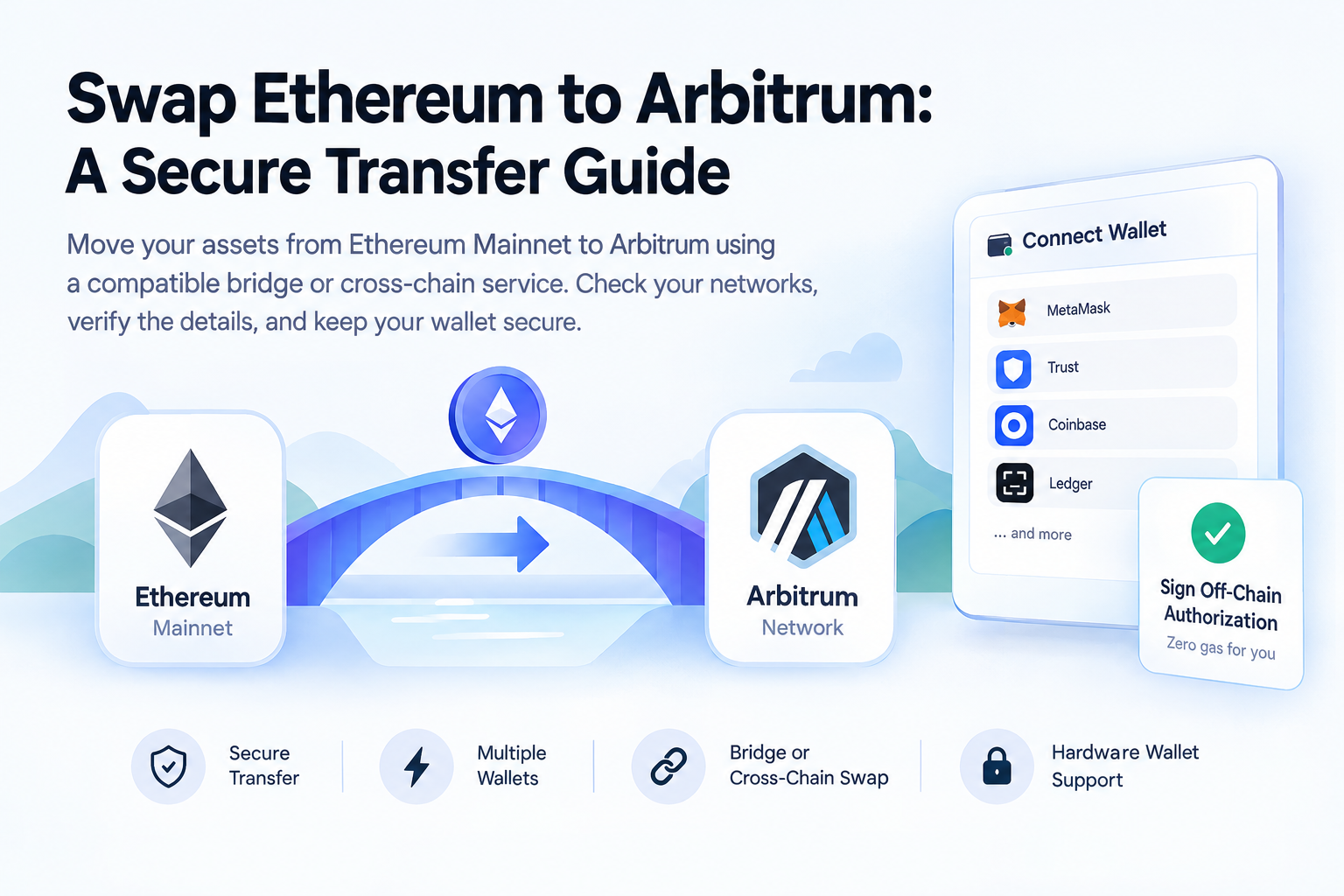
Swap Ethereum to Arbitrum: A Practical Bridge Guide
Swap Ethereum To Arbitrum: What You Need to Know
To Swap Ethereum To Arbitrum, use a bridge or cross-chain swap service that supports Ethereum Mainnet as the source and Arbitrum as the destination. Connect your wallet, select the asset and destination network, review the estimated output and fees, and approve only the transactions you understand.
Ethereum Mainnet and Arbitrum are separate networks. A bridge provides a way to transfer assets between them. Your wallet may need to switch networks to show the funds after the transfer completes. See the official Ethereum bridge guide for the general process.
Onchain is a web dApp on Ethereum Mainnet that uses Permit2, a Uniswap contract, for token authorization. Its described process involves connecting a wallet, approving Permit2, and signing an off-chain authorization. That authorization process is not, by itself, proof that a bridge transfer to Arbitrum will occur. Confirm that the selected Onchain route explicitly supports your intended asset and destination before signing.
|
Option |
Best suited for |
What to check |
|
Native Arbitrum bridge |
Moving ETH from Ethereum Mainnet to Arbitrum |
Destination network, transaction fees and estimated arrival |
|
Cross-chain swap service |
Swapping assets while moving between networks |
Supported tokens, exchange rate, route and service fees |
|
Token authorization with Permit2 |
Authorizing supported token actions |
Contract address, token allowance and requested permissions |
|
Exchange withdrawal to Arbitrum |
Moving funds from a centralized exchange |
Whether the exchange supports Arbitrum withdrawals |
The right option depends on whether you want to transfer ETH, swap one token for another, or authorize a token operation. These are related but distinct actions.
For reference, the official Permit2 contract address provided for Onchain is 0x000000000022D473030F116dDEE9F6B43aC78BA3. Verify the network and contract before approving any permission. Never treat a familiar contract address as proof that an entire website or transaction is safe.
Step-by-Step: How to Swap Ethereum To Arbitrum
- Choose a supported bridge or swap route. Open a service's official website directly. Confirm that it supports Ethereum Mainnet, Arbitrum, and the specific asset you want to transfer before connecting your wallet.
- Connect your wallet. Select the wallet holding your ETH or tokens on Ethereum Mainnet. Check the website address carefully, and reject unexpected connection requests or prompts to disclose your recovery phrase.
- Select the source and destination networks. Set Ethereum Mainnet as the source and Arbitrum as the destination. If you want to transfer ETH rather than exchange it for another asset, make sure the route matches that intention.
- Enter the amount and review the quote. Check the amount leaving your wallet, the estimated amount arriving, fees, exchange rate and any displayed minimum. Quotes can change, so review the final details before confirming.
- Inspect each wallet request. Read the transaction or signature request. If a service asks for token approval or a Permit2 authorization, verify the contract, token, permission scope and any expiration details shown. Cancel if the request is unclear.
- Confirm the required transaction. Complete the on-chain transaction in your wallet if the chosen route requires one. An off-chain signature may not itself require a blockchain transaction fee, but that does not mean the entire bridge or swap is gas-free.
- Track the transfer. Use the service's transaction status or the relevant block explorer to check progress. Wait for confirmation before assuming the transfer is complete.
- Check your Arbitrum balance. Switch your wallet to Arbitrum and verify that the expected asset arrived. If it is not visible, check the transaction status and token details before attempting another transfer.
The native Arbitrum bridge is one option for transferring ETH from Ethereum Mainnet to Arbitrum. Compare the route and its requirements before proceeding.
Where does Onchain fit into this process?
Onchain's stated workflow focuses on token authorization through Permit2. Users connect a supported wallet, approve the Permit2 contract, and sign an off-chain authorization. The server wallet pays the gas associated with the signing workflow as described by Onchain.
That does not establish that every route on the Onchain swap interface supports bridging ETH to Arbitrum. Before using Onchain Swap, verify the available networks, tokens, quote and transaction details on the live interface. Check the official Onchain page for current details.
For background on token permissions, consult Uniswap. Understand what you authorize before signing; an off-chain signature can still carry meaningful permission or security implications.
Common Issues and How to Fix Them
- Arbitrum does not appear as a destination: Check the service's supported networks and confirm that the selected route is available.
- Your wallet shows the wrong network: Switch to Ethereum Mainnet for the source transaction, then to Arbitrum to check the destination balance.
- The transfer is pending: Review the transaction on the appropriate block explorer and follow the bridge's status information before retrying.
- ETH arrived, but the balance looks incorrect: Confirm the destination address, token, network and transaction status. Check whether the quoted output included fees.
- A signature or approval looks unfamiliar: Reject the request and verify the website, contract address and permission details before trying again.
- The interface reports an error: Refresh only after checking transaction status. Use the service's official support channels if the issue remains unresolved.
If you have already granted a token approval you no longer need, review it and consider revoking unnecessary permissions using a trusted tool. Revoking an approval may require a separate on-chain transaction. Ethereum.org provides guidance on revoking smart contract access.
How to Contact Onchain Support Safely
Onchain offers support through its in-app chat in the bottom-right corner and its Telegram group. Onchain does not offer phone support.
Use the channels linked from the official website rather than relying on unsolicited direct messages or search advertisements. Be especially cautious if someone claims they can recover funds, fix a failed bridge instantly, or unlock your wallet for a payment.
Onchain staff will never ask for your seed phrase, private key, or 2FA code.
Never share your wallet recovery phrase or private keys with anyone. Do not approve an unfamiliar transaction simply because a support representative tells you to. If you are uncertain, stop and verify the request through an official channel.
Official resources:
Frequently Asked Questions
How do I bridge Ethereum to Arbitrum using a hardware wallet?
You can bridge ETH from Ethereum Mainnet to Arbitrum using a compatible bridge and a hardware wallet connected through its supported wallet interface. Select both networks, review the transfer details, and approve the required transactions on your hardware wallet. Never sign a request you cannot verify.
Can I swap ETH from Ethereum to Arbitrum without paying gas?
A cross-chain transfer may involve fees even when a particular signing step is gas-free. Onchain states that users pay zero gas for its off-chain signing workflow because its server wallet pays the associated gas. This does not establish that a complete Ethereum-to-Arbitrum bridge transfer has zero fees.
What is the difference between an Ethereum to Arbitrum bridge and a swap?
A bridge moves assets between networks, while a swap exchanges one asset for another. Some cross-chain swap services combine both operations into one route. Review the source asset, destination asset, estimated output and fees to confirm that the selected service matches your intended transaction.
How can I transfer ETH to the Arbitrum network safely?
Use a bridge that explicitly supports Ethereum Mainnet and Arbitrum, and verify every transaction before signing. Check the destination address, expected output, network selection and transaction status. For hardware wallets, review the details displayed by the wallet and reject unexpected permission requests.
Does Onchain support Ledger, Trezor and other hardware wallets?
Onchain lists several hardware-wallet connection methods, including Ledger through MetaMask, Trezor through Rabby, and Tangem and Safe through WalletConnect. These connection methods do not automatically confirm that a specific Arbitrum route is available. Check the live swap interface for current network support.
Key Takeaway Box
To Swap Ethereum To Arbitrum, select a bridge or cross-chain swap service that supports both networks, compare fees and estimated output, and verify every wallet request before signing. Onchain provides Permit2-based token authorization on Ethereum Mainnet, but confirm that your intended Arbitrum route is supported before proceeding. Try Onchain at onchaindiagnois.com.
Ready to try Onchain?
Visit the official Onchain website to review its wallet connection options and Permit2 authorization workflow. If your goal is to move ETH to Arbitrum, first confirm that the live swap interface supports the exact network pair and asset you need.
You can also explore the Onchain Handbook for additional information.
Comments
Post a Comment